Why Short Casual Games Are Worth Your Break Time
By DD Games Team6 min read
Table of contents
Short casual games often get dismissed as a way to waste time. Played with a bit of intention, though, a five-minute puzzle or a quick round with a friend can be a genuinely good use of a break. This article looks at why short casual games are worth your time, what they can and cannot do, and how to choose ones that leave you feeling better rather than more distracted.
What counts as a short casual game?
A short casual game is one you can learn in under a minute and finish in a few minutes. There is no long story, no grinding and no need to commit an evening. Classic examples include word puzzles, sliding tile games, card games and quick strategy duels.
Many of the best ones are very old. Tic-tac-toe, dots and boxes and memory card games were pencil-and-paper or kitchen-table pastimes long before screens. Others, like 2048 and Wordle-style word games, are modern but follow the same idea: simple rules, fast rounds, and just enough challenge to hold your attention.
A quick note on claims
You will see plenty of bold promises online about games "boosting your IQ" or "preventing memory loss". Be sceptical of them. Research on games and the brain is ongoing and often more nuanced than headlines suggest, and a casual game is not a medical treatment.
What follows is about everyday experience: what a short game is good for in your day, and how it fits alongside the things that actually matter for wellbeing, like sleep, movement and time with people.
Reason 1: A clean mental break
Switching to a short, absorbing game can be a useful way to step away from work or study for a few minutes. Unlike scrolling a feed, a game has a clear start and a clear end. When the round is over, the break is over too.
That natural stopping point is the key. A single round of Wordle Duel or a two-minute race in 2048 is a contained activity, which makes it easier to return to what you were doing.
Make it a ritual, not a habit loop
A simple rule helps: decide how many rounds you will play before you start. One game of Minefield on Easy, one Wordle, then back to work. Short games are best when they stay short.
Reason 2: Practising focus in small doses
Many casual games reward paying close attention for a short time. In Memory Match you have to remember where each card was. In Minefield every number is a clue, and one careless click ends the run. In 2048 you have to plan a few moves ahead to keep your board from jamming up.
None of this is a substitute for real-world skills, but it is an enjoyable way to spend a few minutes being fully absorbed in one thing. Many people find that experience refreshing in a day that is otherwise full of interruptions.
Reason 3: Learning to think a move ahead
Strategy games, even simple ones, are built around a habit that is useful everywhere: asking "what happens next?" before acting.
- In Connect Four, every disc you drop opens the slot above it for your opponent.
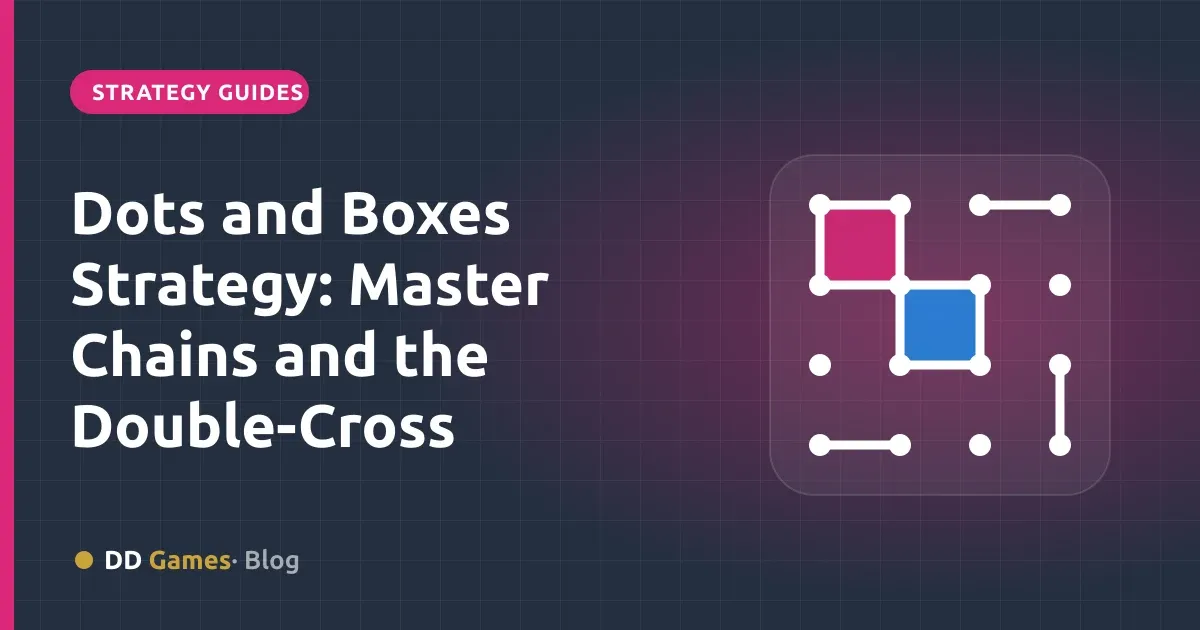
- In Dots & Boxes, drawing the third side of a box hands it to the next player.
- In Chess and Checkers, every move changes what your opponent can attack.
Short games let you practise this kind of thinking with low stakes and fast feedback. You see the consequence of a bad move within seconds, and the next game starts straight away.
Reason 4: Connecting with other people
Some of the most valuable gaming moments are not about the game at all. A quick round of Uno with a cousin in another city, a Raja Rani match with old school friends, or a Quick Draw session with a remote team gives people a reason to talk.
Casual multiplayer games are particularly good at this because they are easy for everyone to join. Nobody needs to be a "gamer" to guess a drawing or play a matching card. Our guide to online game night ideas has formats built around exactly this.
Reason 5: Low-pressure fun for all ages
Short casual games work across generations in a way that many bigger games do not. A grandparent who knows Ludo, a child who loves Snakes & Ladders and a teenager who plays Wordle can all sit down to something together.
Luck-based games like Snakes & Ladders even the field completely, while games like Memory Match often favour younger players. That mix helps everyone feel they have a real chance of winning.
Choosing the right game for the moment
Different games suit different moments. Here is a simple guide.
| You want | Try | Why |
|---|---|---|
| A quiet solo break | Minefield, Snake, Classic 2048 | Clear rounds, personal bests |
| A word workout | Wordle Duel | One puzzle, six guesses |
| Something social | Uno, Raja Rani, Quick Draw | Easy to join, lots of conversation |
| A quick duel | Connect Four, Tic Tac Toe | Rounds take a few minutes |
| A deeper think | Chess, Checkers, Dots & Boxes | Rewards planning ahead |
Keeping casual gaming healthy
Short games are best when they stay a small, positive part of your day. A few habits help.
- Set a round limit before you start. It is easier to stop at a number you chose in advance.
- Prefer games with an end. Rounds, matches and runs are better break material than endless feeds.
- Play with people when you can. Shared games turn screen time into social time.
- Take breaks from the screen too. Stand up, stretch and look away now and then.
- Notice how you feel afterwards. If a game leaves you frustrated rather than refreshed, try a different one.
Where to start on DD Games
Every game on DD Games is free, runs in the browser and needs no download, so you can play a quick round on a phone or laptop whenever you have a few minutes. Solo games like Minefield and Snake save your best score or best time on your device, which gives you something to beat next time.
If you want to share the break with someone else, most games also offer Pass & Play on one device and Online rooms with a shareable code. For a full list of games that work well with friends, see our round-up of the best free browser multiplayer games.
FAQ
Are short casual games good for you?
They can be a pleasant, contained way to take a break, practise focus and connect with others. They are not a medical treatment, and they work best alongside sleep, exercise and time with people.
How long should a casual gaming break be?
There is no single right answer, but deciding on a fixed number of rounds before you start makes it easier to keep a break short and return to what you were doing.
Which casual games are best for a quick solo break?
Games with a clear end work best, such as Minefield, Snake, Classic 2048 or a single Wordle round. Each round is short and gives you a natural stopping point.
Can casual games help me think ahead?
Strategy games like Connect Four, Chess and Dots & Boxes reward thinking about the next move, and short rounds give fast feedback. Treat it as an enjoyable way to practise, not a guaranteed skill boost.
Ready to play?
Pick a game that fits your next break. Try a single round of Wordle Duel for a word workout, or clear a quick field in Minefield and see if you can beat your best time.