Dots and Boxes Strategy: Master Chains and the Double-Cross
By DD Games Team7 min read
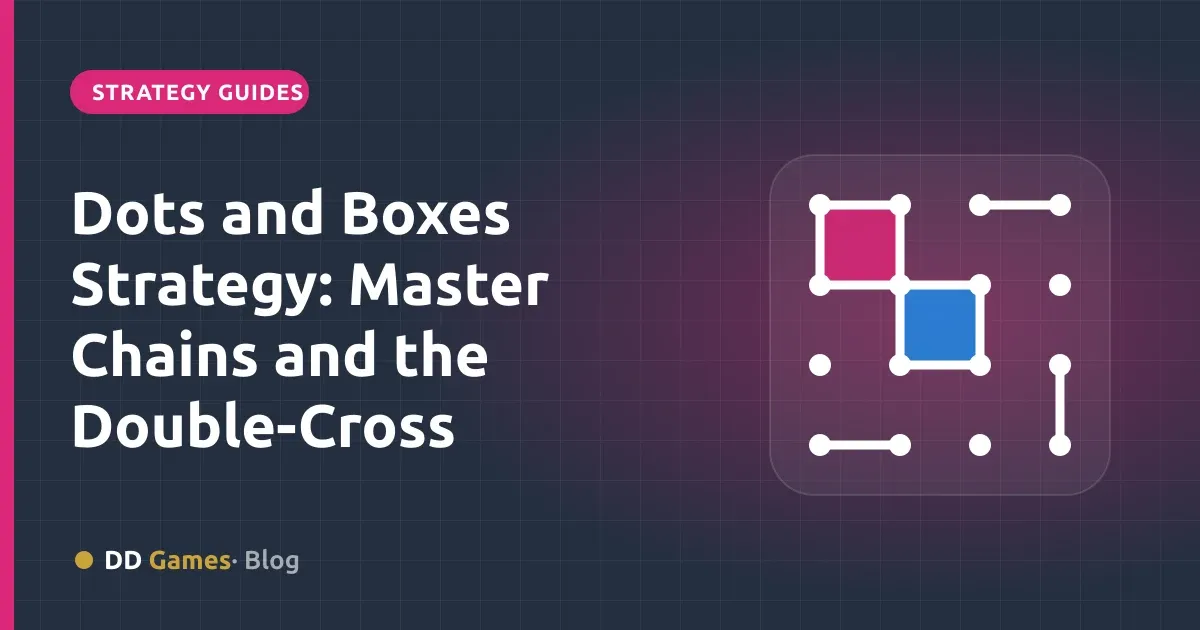
Table of contents
Dots and Boxes is one of those games most people played on the back of a notebook and assumed was mostly luck. It is not. Once you understand chains and the double-cross, Dots and Boxes strategy turns into a battle over who is forced to give away the big prizes at the end. This guide explains the rules on DD Games and the chain tactics that win games.
The rules on DD Games
DD Games Dots & Boxes follows the classic pencil-and-paper rules.
- Choose a board of 3x3, 4x4 or 5x5 boxes. The default is 4x4, which has 16 boxes and 40 lines. Online, the host chooses the size before the first line is drawn.
- On your turn, draw one line between two neighbouring dots, horizontally or vertically.
- If your line closes the fourth side of a box, that box is yours and you draw again. One line can close two boxes at once.
- A line that closes nothing passes the turn to the next player.
- When every line has been drawn, the player with the most boxes wins. A shared top score is a draw.
The game supports 2 to 4 players. Most of the strategy below is written for two-player games, where it is cleanest, but the core ideas help in bigger games too.
The three phases of a game
Thinking about a game in phases makes the strategy much easier to follow.
- The opening. Lots of safe lines are available. Nobody needs to give anything away.
- The middle. Safe lines run out. Players start shaping the board into chains, the corridors of boxes that will be given away later.
- The endgame. There are no safe lines left. Every move opens a chain or loop, and the fight is about who has to open the long ones.
Beginners focus on the boxes in front of them. Strong players focus on the shape of the board heading into phase three.
Rule one: never draw the third side
The most basic rule is to avoid drawing the third side of a box. If a box has three sides drawn, the next player simply closes it and draws again.
In the opening and middle of the game, there are usually plenty of lines that do not create a third side. Use them. Only give a box away when you have no other choice.
Understanding chains and loops
As the board fills, the remaining open areas form structures.
- A chain is a line of boxes connected so that once one is taken, the next can be taken, and so on. A chain of three or more boxes is called a long chain.
- A short chain has one or two boxes.
- A loop is a chain that joins back on itself, so it has no open ends.
When a player is forced to draw a line inside a chain, the opponent can usually take every box in it. In the endgame, the question becomes who has to open each chain.
| Structure | Boxes | What happens when it is opened |
|---|---|---|
| Short chain | 1 to 2 | Opponent takes it; the sacrifice is small |
| Long chain | 3 or more | Opponent can take all of it, or use the double-cross |
| Loop | 4 or more | Opponent can take all of it, or decline the last four |
The double-cross: the most important trick
Here is the idea that separates beginners from strong players. When your opponent opens a long chain, you do not have to take every box.
- Take all but the last two boxes of the chain.
- Instead of taking the final two, draw the line at the far end of the chain. This leaves the two boxes joined together, ready to be closed with a single line.
- Your turn ends. Your opponent takes the two boxes with one line, but then they must move again and open the next chain.
You give up two boxes, but you keep control: your opponent has to open every remaining chain for you. On a board with several long chains, this usually wins by a wide margin.
For a loop, the same trick works by declining the last four boxes instead of two. Loops cost the controlling player more, which is why giving away a loop is sometimes a good defensive move.
When to keep control and when to cash in
Control is not free: every double-cross hands over two boxes, or four in a loop. Before declining, count roughly how many boxes are left in the remaining chains. If keeping control wins more than you sacrifice, keep it. On the very last chain, there is nothing left to control, so take every box.
Handing out short chains well
When you are forced to give boxes away and only short chains are left, how you give them matters.
- For a single box, there is only one way: it gets taken.
- For a two-box chain, draw the middle line between the two boxes rather than an end line. This splits them so your opponent must take both and cannot use the double-cross to pass the move back to you.
This small detail, sometimes called the "hard-hearted handout", stops your opponent from keeping control cheaply.
The long chain rule (two-player games)
For two-player games on a rectangular board, there is a famous rule of thumb from mathematician Elwyn Berlekamp's study of the game. It tells you how many long chains you want to end up with.
- The first player wants the number of dots plus long chains to be even.
- The second player wants that number to be odd.
Loops do not change this count. On the default 4x4 board there are 25 dots, which is odd. So the first player wants an odd number of long chains, and the second player wants an even number. On 3x3 boxes (16 dots) and 5x5 boxes (36 dots), the first player wants an even number instead.
You do not need to calculate this perfectly. Simply knowing which parity you want lets you make middle-game decisions, such as whether to split a long region into two chains or merge two chains into one.
Common Dots and Boxes mistakes
- Drawing the third side of a box when a safe line is available.
- Grabbing every box of every chain instead of using the double-cross.
- Using the double-cross on the last chain and throwing away two boxes for nothing.
- Giving away a two-box chain with an end line, letting your opponent keep control.
- Paying no attention to the shape of the board until the safe lines are gone.
Playing with three or four players
With more than two players, control is harder to hold because the move does not simply bounce back to you. The basic rules still apply: avoid third sides, give away the smallest chain you can, and look for chances to take long chains. The double-cross is still useful, but think about who will be forced to move after your opponent takes the two boxes.
How to practise on DD Games
Dots & Boxes is free to play in your browser with no download. Choose Singleplayer against Easy, Medium or Hard bots, Local to pass one device around, or Online for 2 to 4 players with a shareable room code. The 3x3 board is a good place to practise the double-cross, since chains form quickly and games are short.
If you enjoy games about forcing your opponent's hand, our checkers strategy guide explores the same idea with forced captures. And for a quick, related warm-up, Connect Four rewards the same habit of thinking about what each move gives away.
FAQ
Do I get another turn after closing a box?
Yes. Every time your line completes a box you draw again, so one move can win a whole chain of boxes. One line can even close two boxes at once.
What is the double-cross in Dots and Boxes?
When your opponent opens a long chain, you take all but the last two boxes and then draw the line at the end of the chain. Your opponent takes those two boxes but must then open the next chain for you.
How big is the Dots & Boxes board?
You can play 3x3, 4x4 or 5x5 boxes. The default is 4x4, which has 16 boxes and 40 lines.
What is the long chain rule?
In two-player games, the first player wants the number of dots plus long chains to be even, and the second player wants it odd. On a 4x4 box board with 25 dots, the first player wants an odd number of long chains.
How many players can play Dots & Boxes?
Two to four players in local or online play. In singleplayer, Easy, Medium or Hard bots fill the other seats.
Ready to play?
Try the double-cross for yourself in a game of Dots & Boxes. Start on a 3x3 board against the Medium bot, then move up to 4x4 once you are comfortable counting chains.