Connect Four Strategy: How to Win More Often
By DD Games Team6 min read
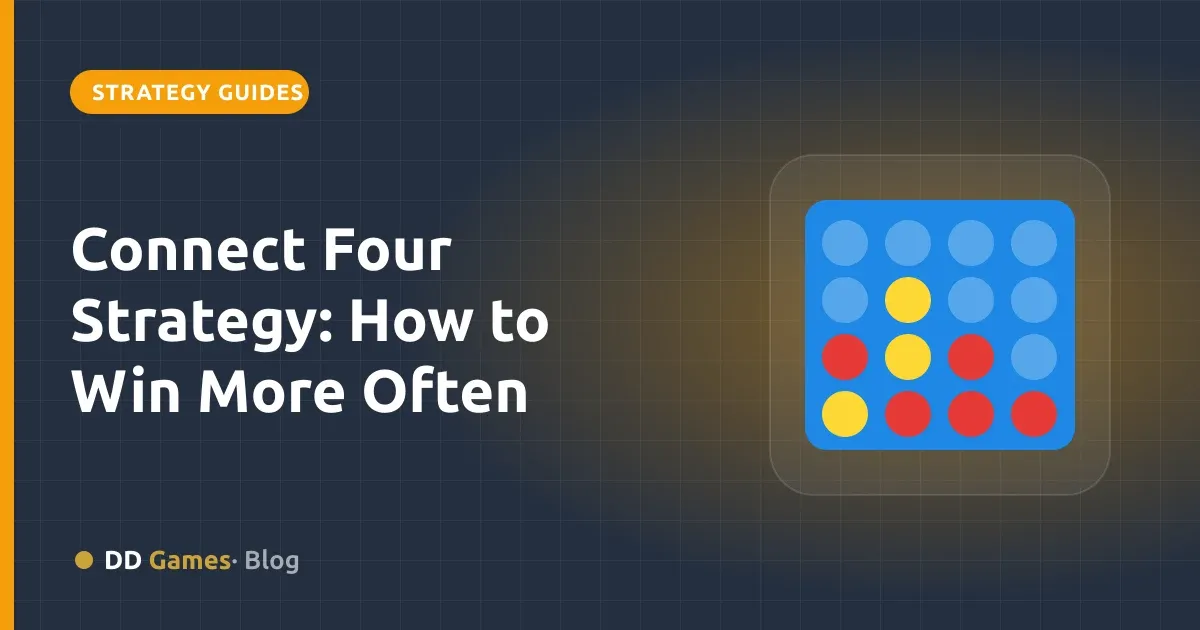
Table of contents
Connect Four takes seconds to learn and a long time to master. Most games between casual players are decided by one simple oversight, which means a little Connect Four strategy goes a long way. This guide covers how to win at Connect Four with the ideas strong players rely on: the centre column, threat building, the 7-trap and the odd-even rule.
The rules in thirty seconds
Connect Four is played on a grid 7 columns wide and 6 rows tall. Two players take turns dropping a disc into any column, and the disc falls to the lowest empty slot. The first player to connect four discs in a row horizontally, vertically or diagonally wins, and if all 42 slots fill with no line of four, the game is a draw.
On DD Games Connect Four, a full column cannot be played, and the first player alternates between rematches so neither side keeps the first-move advantage.
Why Connect Four is not just luck
There are no dice and no hidden information in Connect Four. Every outcome comes from the moves the two players choose. In fact, the game has been solved: with perfect play, the first player can always force a win by starting in the centre column.
You do not need to memorise perfect play to benefit from that fact. It tells you that structure matters, that the centre is special, and that the player who understands threats will beat the player who just reacts.
Strategy 1: Own the centre column
The centre column is part of more possible lines of four than any other column. A disc in the middle can join horizontal lines stretching left and right as well as both diagonals. A disc on the edge column can only join lines going one way.
Practical rules of thumb:
- Open in the centre when you move first.
- When you move second, it is usually fine to stack on the centre too.
- Prefer the three middle columns over the outer ones early in the game.
The Hard bot on DD Games favours the centre for exactly this reason. If you want to see how central control feels from the losing side, play it once without contesting the middle.
Strategy 2: Think about the slot above
Connect Four has a twist that tic-tac-toe does not: gravity. Every disc you drop makes the slot directly above it playable. Strong players ask two questions before every move.
- What line does this disc help me build?
- What slot does this disc open up, and who benefits from it?
If your opponent has three in a row with an empty slot waiting for a fourth disc, never drop a disc directly underneath that slot. You would be handing them the winning square.
Strategy 3: Build threats, not just lines
A "threat" is an empty slot that would complete four in a row for you. Lines of three are only useful if the fourth slot is actually reachable, either now or later.
Good threats share a few traits.
- They are not immediately blockable. A threat that your opponent can simply fill next turn only costs them one move.
- They sit higher up the board. A threat hanging in mid-air cannot be blocked until the column fills up to it, so it constrains your opponent for the rest of the game.
- They come in groups. One threat can be managed; two threats usually cannot.
Strategy 4: Set up the 7-trap
The 7-trap is a classic pattern named for its shape. You arrange discs so that you have two threats stacked one on top of the other in the same column, or so that blocking one threat forces your opponent to open another.
Here is the idea in practice. Suppose you have a threat in a slot two rows up in column 5, and another threat directly above it.
Your opponent cannot block the upper one until the lower one is filled. When the column fills to the lower threat, either you play it and win, or your opponent blocks it and gives you the slot above. Either way, you win.
Look for patterns where your diagonal and your horizontal line share a common slot or sit on top of each other. Those are the seeds of a 7-trap.
Strategy 5: Learn the odd-even rule
Number the rows 1 to 6 from the bottom. The odd-even rule is one of the deepest ideas in Connect Four, and it can be summarised simply.
| Player | Wants threats on |
|---|---|
| First player | Odd rows (1, 3, 5) |
| Second player | Even rows (2, 4, 6) |
Why does it work? Near the end of a game, when the remaining columns fill up, the order of moves is largely fixed. If both sides simply fill columns, the first player tends to get the odd-row slots and the second player the even-row slots. So a first-player threat on an odd row is likely to come due on the first player's turn, and vice versa.
You will not apply this perfectly in a casual game, but it is a great tiebreaker. When you have two possible threats to build, pick the one on your "good" row parity.
Strategy 6: Force moves to take control
A forcing move is one your opponent must answer, usually because you threaten to win. Forcing moves let you choose where the next disc goes on both sides of the board. Experienced players use a sequence of forcing moves to steer the game into a position where a second threat appears.
Before playing a forcing move, check what the forced reply gives your opponent. A block that also builds their own line is not a good deal for you.
Common Connect Four mistakes
- Ignoring the centre and playing the edges early.
- Dropping a disc directly beneath your opponent's winning slot.
- Building a line of three where the fourth slot is already blocked.
- Reacting to every opponent move instead of building your own threats.
- Forgetting diagonals. Most surprise losses come from a diagonal nobody was watching.
How to practise
The fastest way to improve is to play against a range of opponents. On DD Games you can play Connect Four Solo against an Easy, Medium or Hard bot, switch difficulty between games, use Pass & Play on one device, or open an Online room with a friend. Quick Play finds you a random opponent if you want a stranger's style to test against.
Start on Medium, focus on one idea per session (for example, only the slot-above rule), and move up when you start winning consistently. If you enjoy this kind of pure strategy duel, our guide to checkers strategy uses many of the same ideas about forcing moves and control. Fans of turn-based tactics should also try Dots & Boxes, where controlling who is forced to move last is everything.
FAQ
What is the best first move in Connect Four?
Drop your first disc in the centre column. It belongs to more possible winning lines than any other column, and with perfect play the first player can force a win from there.
Is Connect Four a solved game?
Yes. With perfect play the first player can always force a win by starting in the centre column. In practice, very few human players play perfectly, so solid principles win most games.
What is a 7-trap in Connect Four?
It is a setup where you hold two threats stacked on top of each other, or arranged so that blocking one gives you the other. Your opponent cannot stop both, so you win.
Can I play Connect Four against the computer?
Yes. Solo mode on DD Games offers Easy, Medium and Hard bots, and you can switch difficulty between games.
Ready to play?
Put the centre column, the slot-above rule and the 7-trap to the test in a game of Connect Four. When you want a lighter warm-up, Tic Tac Toe teaches the same basic habit of blocking threats before building your own.